Free PDF · Ages 0 to 4 and 3 to 7 · No email, no sign-up
Over the River and Through the Wood: the Thanksgiving poem, and two free picture books to print
“Over the River and Through the Wood” is a Thanksgiving poem. Lydia Maria Child first published it in the 1840s as “The New-England Boy’s Song about Thanksgiving Day,” and its sleigh ride ends at Grandfather’s house with pumpkin pie. Here are all 12 verses, and two free picture books that set them out, one verse to a page. The book for ages 0 to 4 has cut-paper-style pictures and ends with two short pages about Lydia: the house in Medford that people link to the poem, and her own pumpkin pie. The book for ages 3 to 7 has crayon-style pictures, a kitten to find on every verse page, and eight history pages, from the Wampanoag, the People of the First Light, to Thanksgiving today. Print either one at home on US Letter or A4, or read it as an ebook.
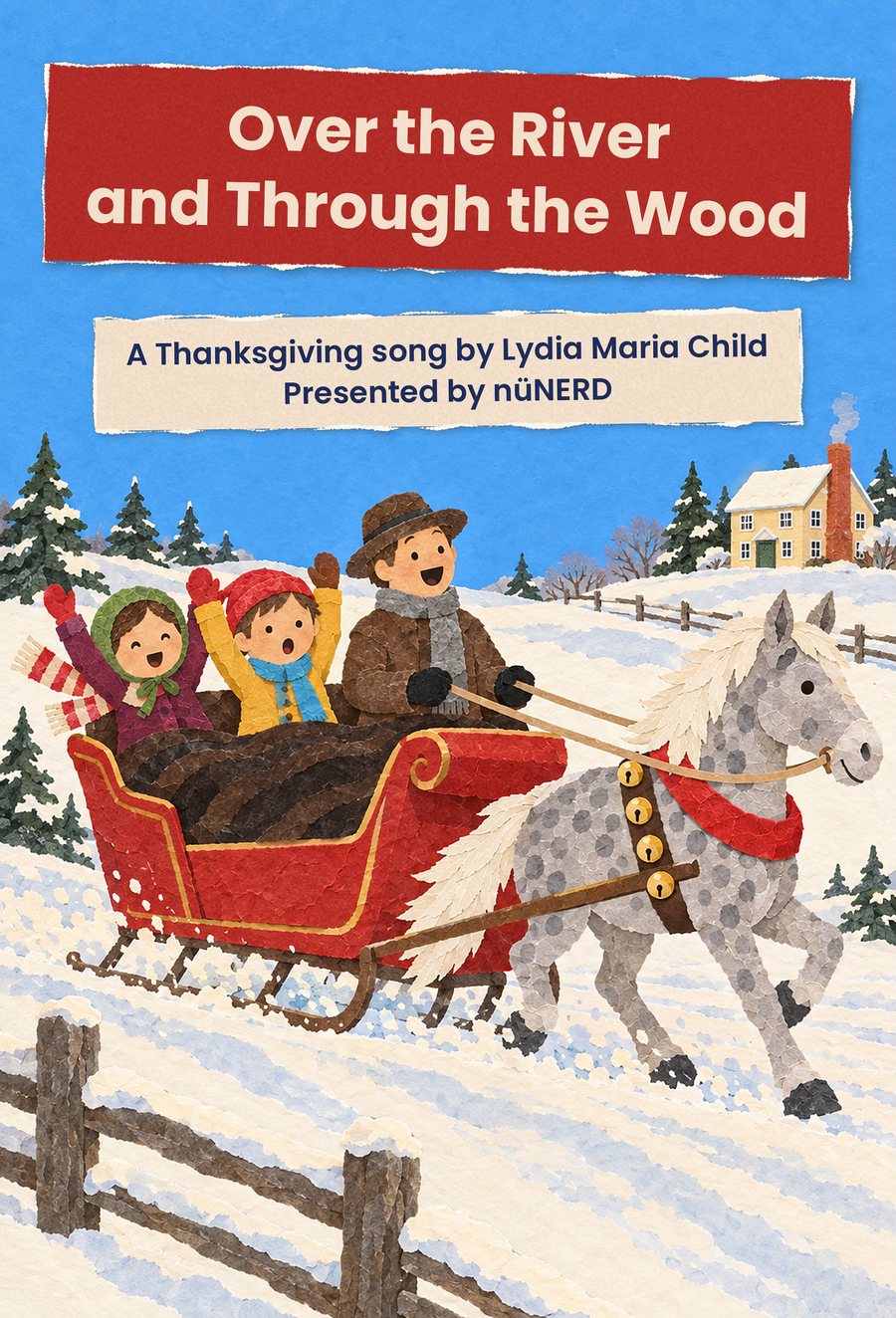
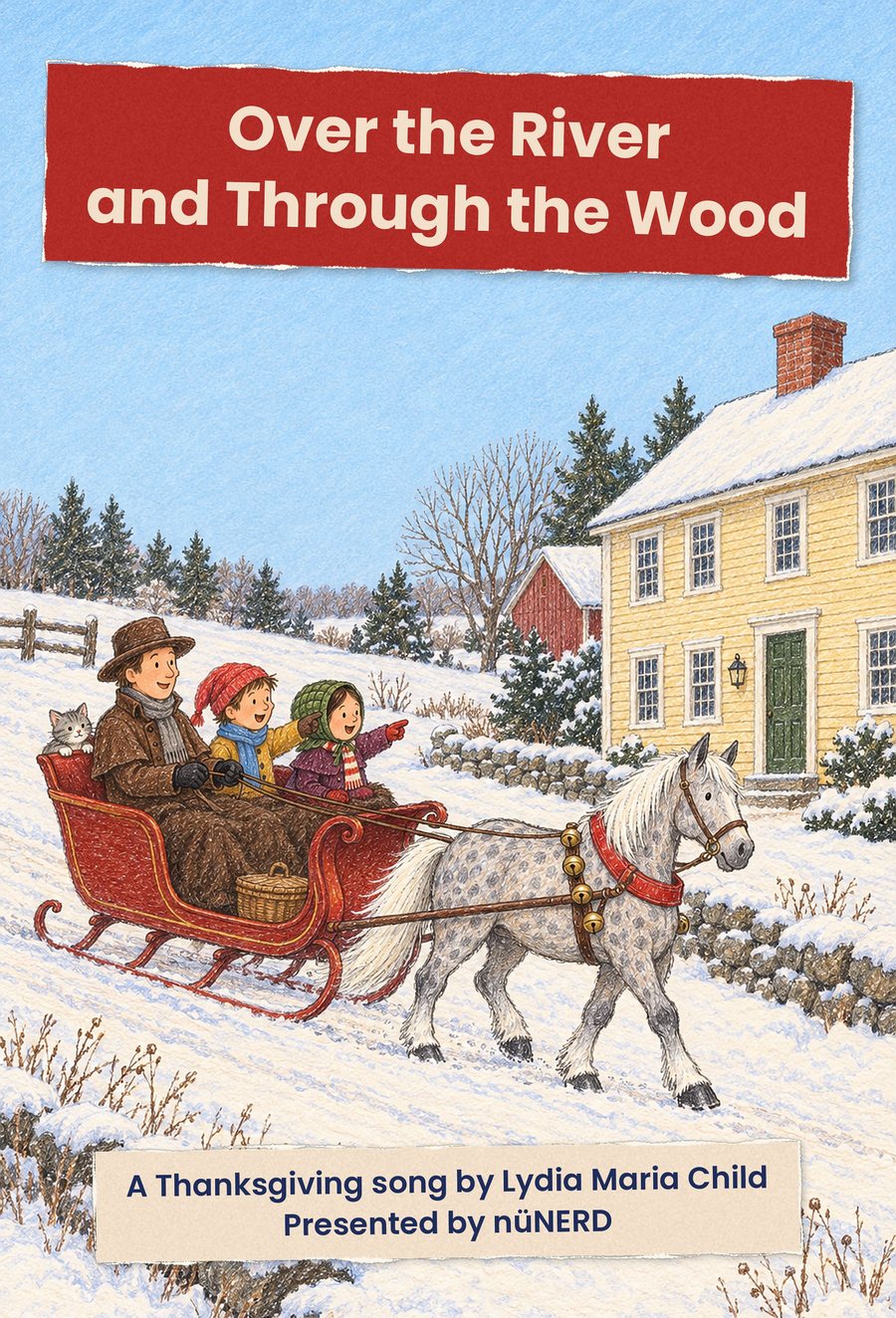
Written for Thanksgiving, not Christmas
The sleigh, the snow, and the bells can make it sound like December, and some sung versions even change “Thanksgiving Day” to “Christmas Day.” But look at the title Child gave it: “The New-England Boy’s Song about Thanksgiving Day.” Two of the verses end “For ’t is Thanksgiving day,” a third cheers “Hurra for Thanksgiving day!”, and the last line of all is “Hurra for the pumpkin pie!” When she wrote it, Thanksgiving was a bigger holiday than Christmas in much of New England.
For babies and toddlers, ages 0 to 4
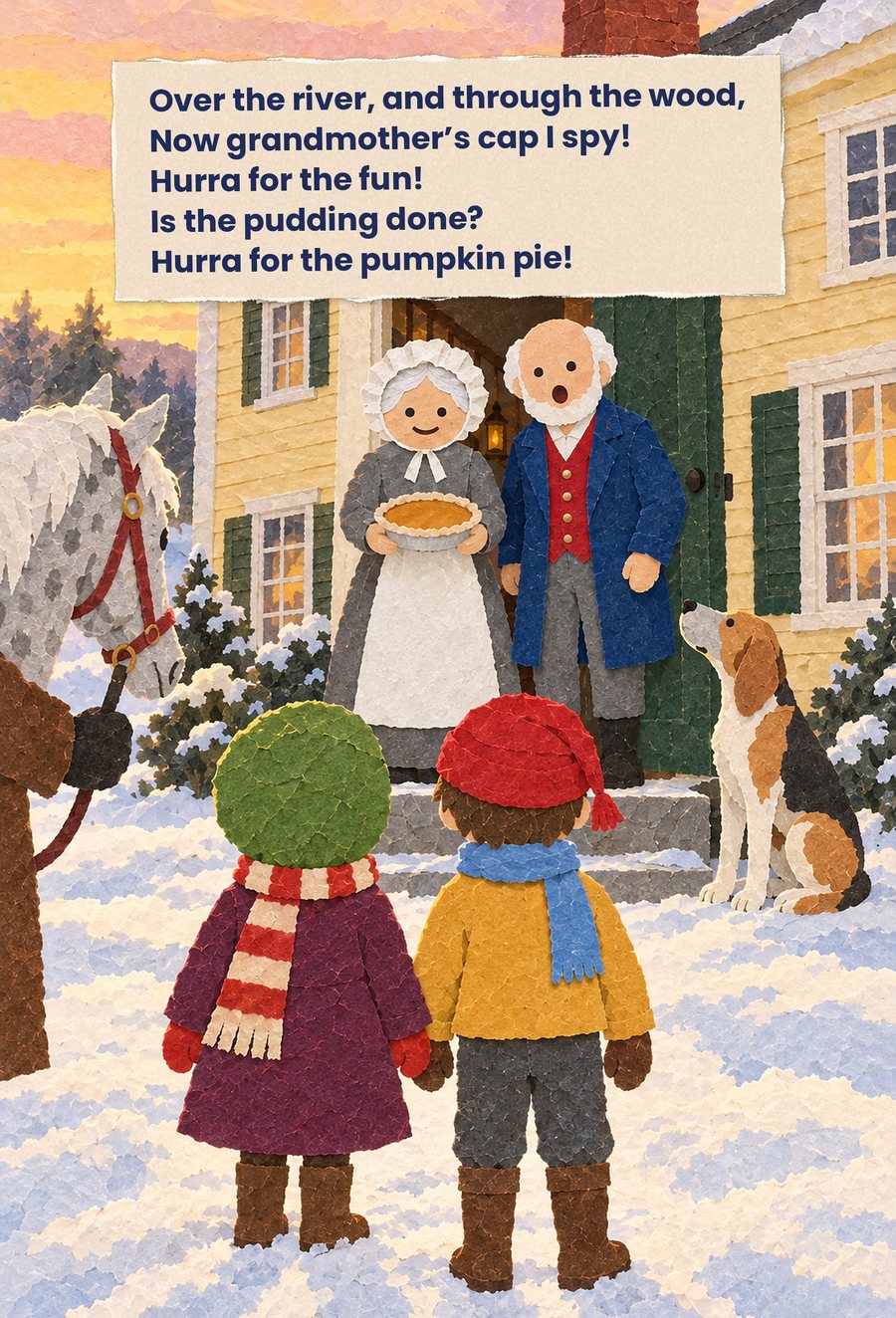
Sixteen pages. The cover, then the 12 verses, one to a page, short enough to read or sing in one sitting. Two pages about Lydia follow: one on “grandfather’s” and “grandmother’s” and the house in Medford, and one on her pumpkin pie, which uses pumpkin, milk, eggs, molasses, cinnamon, and ginger. A back cover closes the book.
Printing on A4? A4 pages · A4 folding booklet. New to the booklet? Here’s how to print and fold it.
Download the ebook, then open it in Apple Books on an iPhone, iPad, or Mac, or in Google Play Books on an Android phone or tablet.
Free for homes, preschools, daycares, and classrooms. Print as many copies as you like, and share the link with anyone.
For children ages 3 to 7
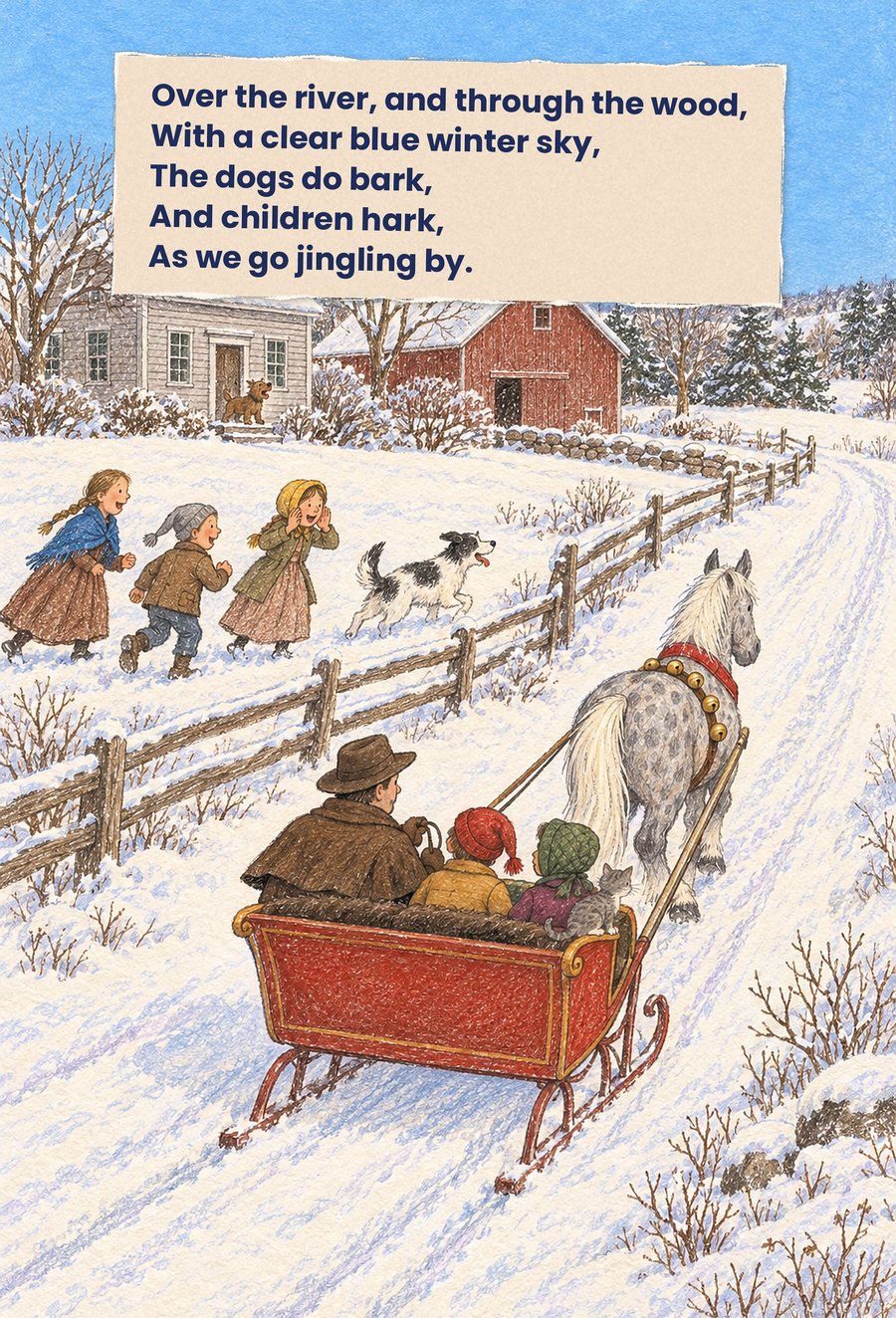
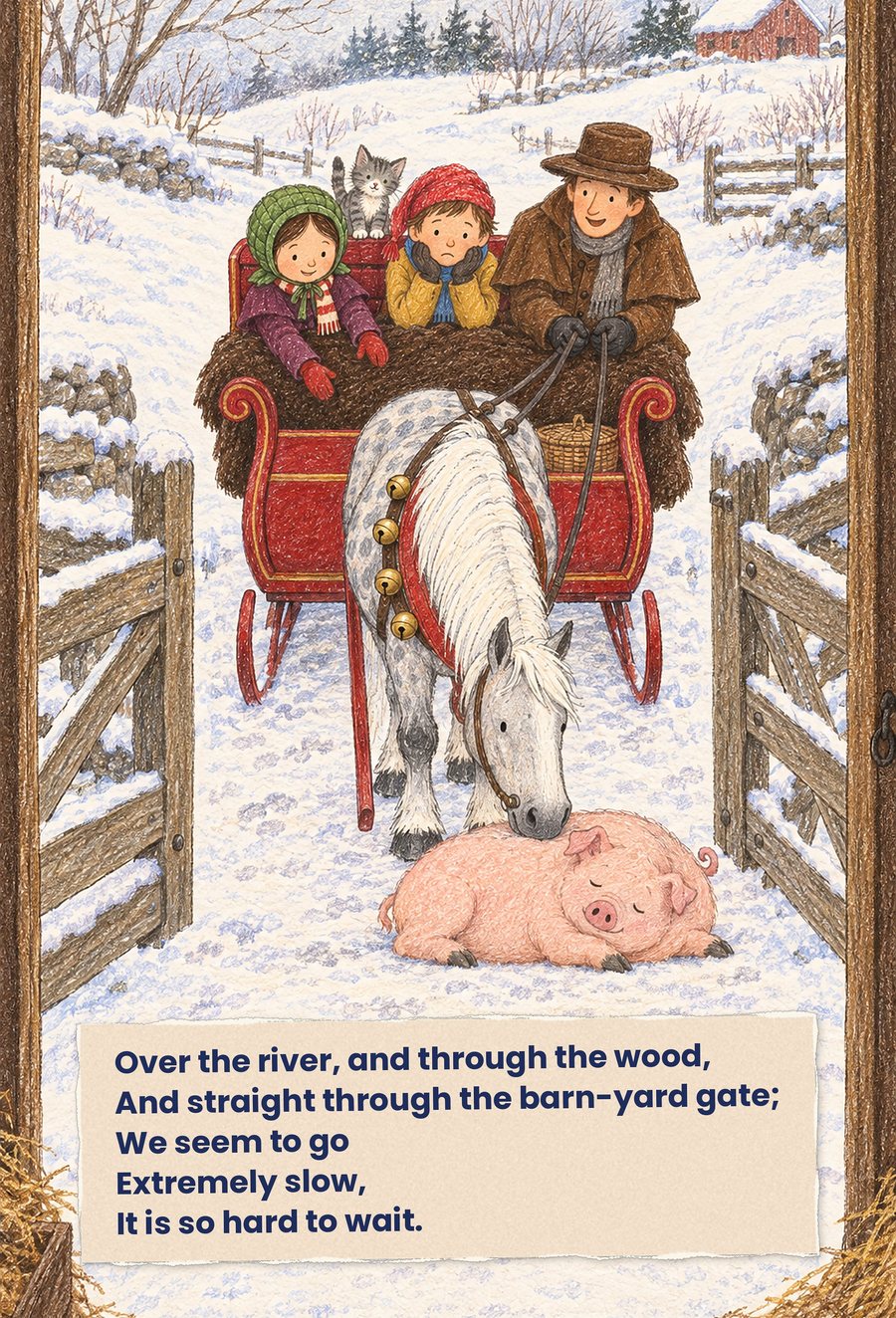
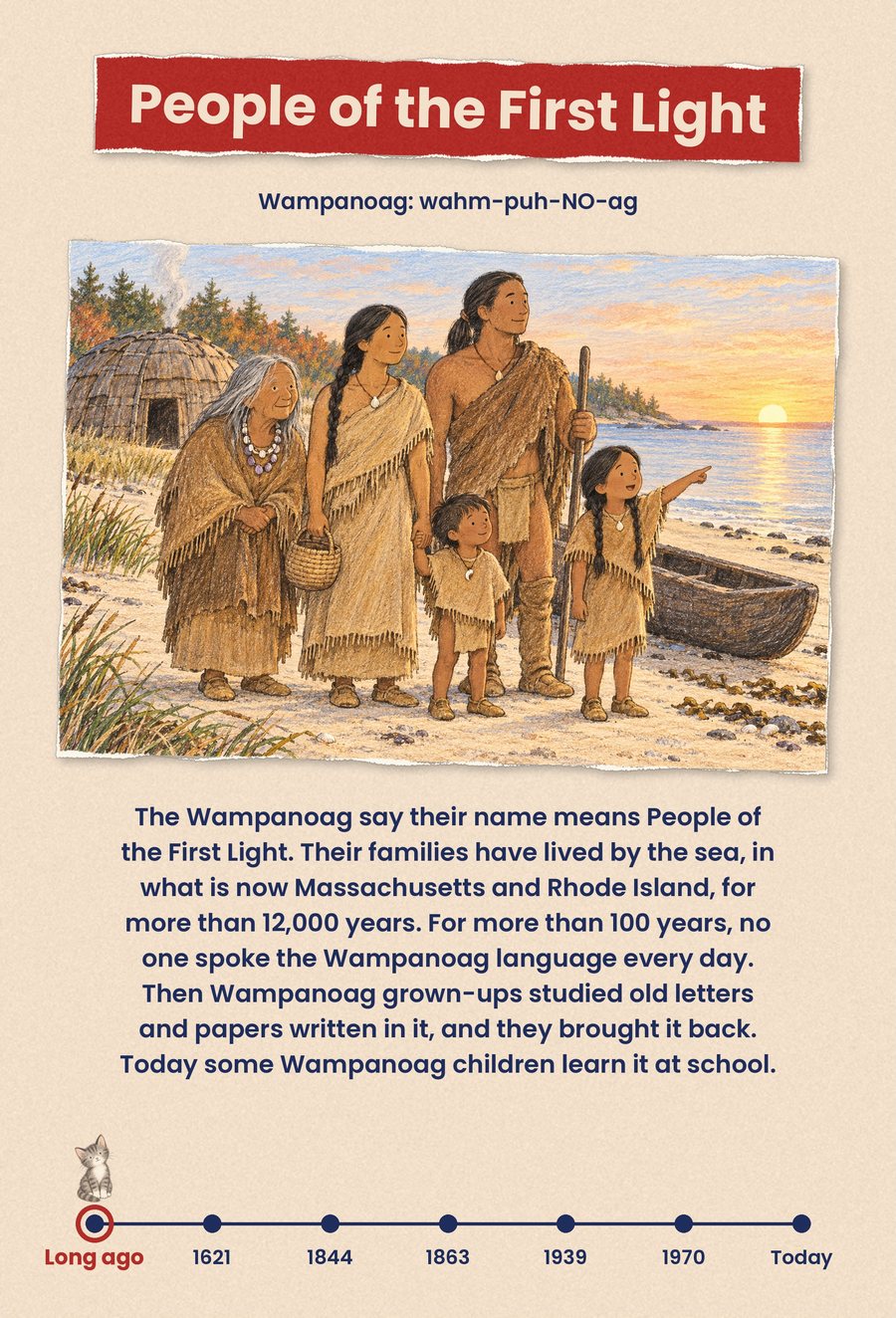
Twenty-four pages. After the 12 verses come eight pages of Thanksgiving history for kids, each with a picture, a short read-aloud, and a timeline that runs from long ago to today:
- People of the First Light: who the Wampanoag are, and how they are bringing their language back.
- Thank you, all year long: Wampanoag thanks for strawberries and corn, and Cranberry Day on Martha’s Vineyard.
- Ninety visitors: the 1621 harvest at Plymouth, and the roughly 90 Wampanoag men who came with their leader, Ousamequin.
- What did they eat?: wild birds, deer, and corn. No pumpkin pie, no potatoes, and no forks.
- Thanksgiving by sleigh: Thanksgiving in New England in the 1840s, and why a Massachusetts sleigh horse had to wear bells.
- Letters, letters, letters: Sarah Josepha Hale, known for “Mary Had a Little Lamb,” and her 17 years of writing for a national Thanksgiving.
- The year with two Thanksgivings: 1939, “Franksgiving,” and Texas.
- Thanksgiving today: Wamsutta Frank James’s 1970 speech on a hill in Plymouth, and how the National Day of Mourning and family feasts now fall on the same day.
Then a “Look again!” page shows where the kitten hides on the cover and each verse page, and a page for the grown-up gives the sources behind the history pages and a reading list, Native sources first. A back cover closes the book.
Printing on A4? A4 pages · A4 folding booklet. New to the booklet? Here’s how to print and fold it.
Download the ebook, then open it in Apple Books on an iPhone, iPad, or Mac, or in Google Play Books on an Android phone or tablet.
Free for homes, preschools, daycares, and classrooms. Print as many copies as you like, and share the link with anyone.
The words (lyrics) to “Over the River and Through the Wood”
Lydia Maria Child’s poem has 12 verses. These are her words, as they appear in both books:
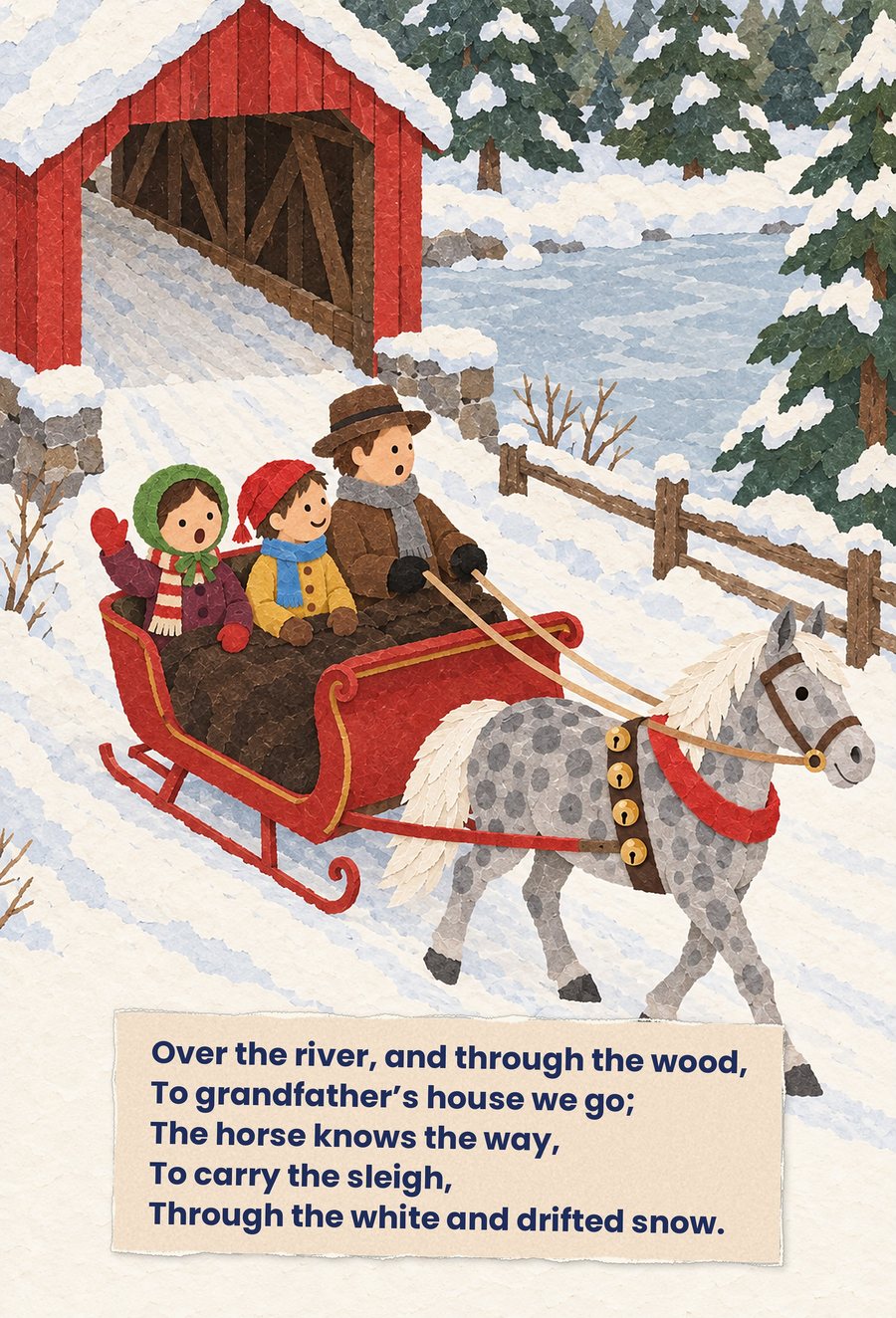
Over the river, and through the wood,
To grandfather’s house we go;
The horse knows the way,
To carry the sleigh,
Through the white and drifted snow.
Over the river, and through the wood,
To grandfather’s house away!
We would not stop
For doll or top,
For ’t is Thanksgiving day.
Over the river, and through the wood,
Oh, how the wind does blow!
It stings the toes,
And bites the nose,
As over the ground we go.
Over the river, and through the wood,
With a clear blue winter sky,
The dogs do bark,
And children hark,
As we go jingling by.
Over the river, and through the wood,
To have a first-rate play.
Hear the bells ring
Ting a ling ding,
Hurra for Thanksgiving day!
Over the river, and through the wood,
No matter for winds that blow;
Or if we get
The sleigh upset,
Into a bank of snow.
Over the river, and through the wood,
To see little John and Ann;
We will kiss them all,
And play snow-ball,
And stay as long as we can.
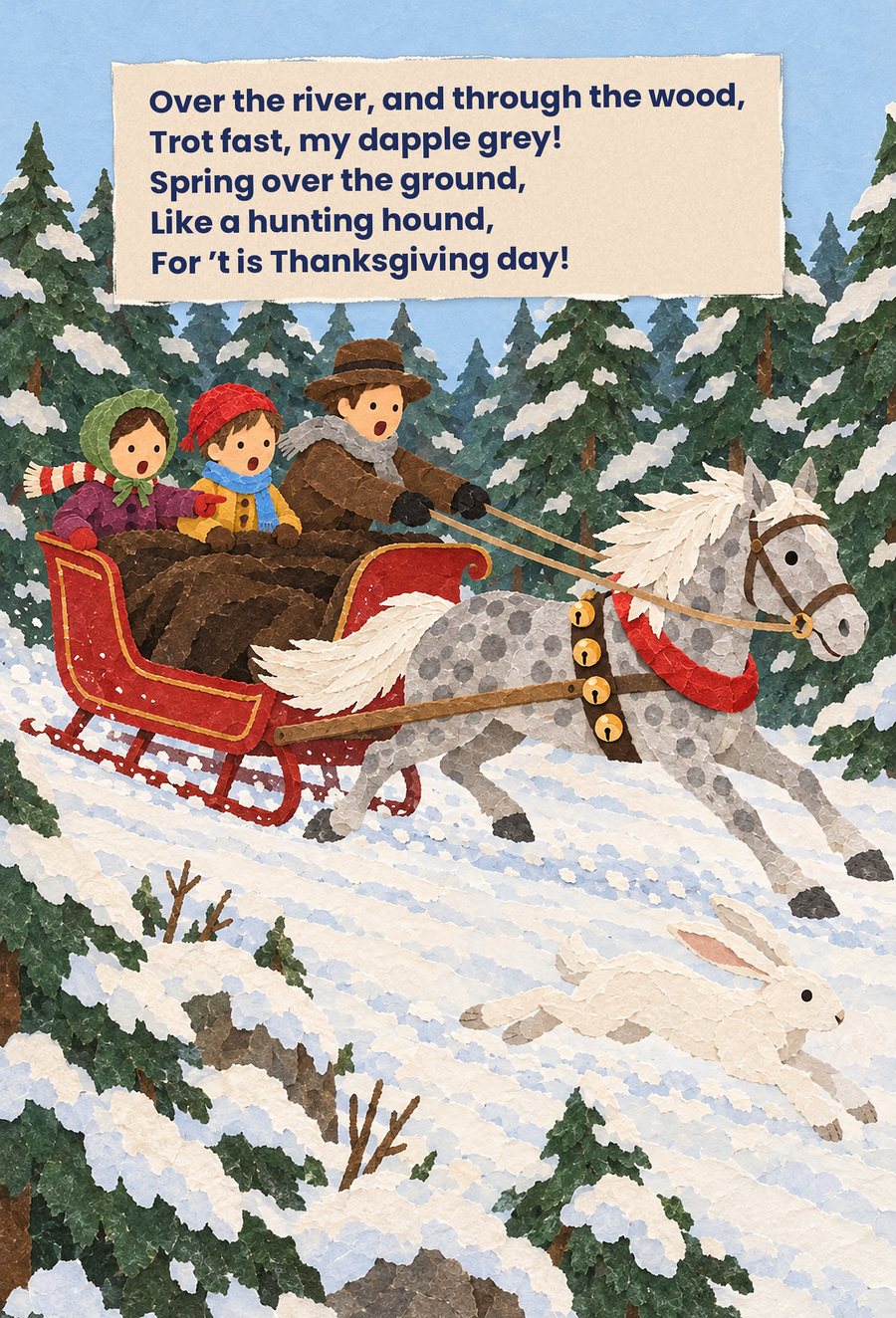
Over the river, and through the wood,
Trot fast, my dapple grey!
Spring over the ground,
Like a hunting hound,
For ’t is Thanksgiving day!
Over the river, and through the wood,
And straight through the barn-yard gate;
We seem to go
Extremely slow,
It is so hard to wait.
Over the river, and through the wood,
Old Jowler hears our bells;
He shakes his pow,
With a loud bow wow,
And thus the news he tells.
Over the river, and through the wood,
When grandmother sees us come,
She will say, Oh dear,
The children are here,
Bring a pie for every one.
Over the river, and through the wood,
Now grandmother’s cap I spy!
Hurra for the fun!
Is the pudding done?
Hurra for the pumpkin pie!
Child wrote it as a poem, not a song. It was set to music later, by a composer whose name is not known.
Is it “grandfather’s house” or “grandmother’s house”?
Child wrote “To grandfather’s house we go” and “through the wood.” Many families now sing “grandmother’s house” and “through the woods.” Both books keep her words, and the ages 0 to 4 book ends with a page about it.
What does the poem mean?
It is a sleigh ride, told in a child’s voice. A family sets off by horse and sleigh on Thanksgiving Day to visit the grandparents. The wind stings their toes and bites their noses, dogs bark and children listen as the bells go by, and nobody minds if the sleigh tips into a snowbank. The child urges the horse to trot fast, finds the last stretch through the barnyard gate “extremely slow,” and hears Old Jowler, the dog, bark the news. The poem ends as Grandmother’s cap comes into view, with a cheer for the pumpkin pie.
A few old words, explained for kids:
- “Hark” means listen.
- “Hurra” is an old spelling of hooray.
- “Pow” is an old word for your head. Old Jowler shakes his head when he barks.
- “Dapple grey” means a gray horse with round darker spots.
Who wrote it?
Lydia Maria Child, born in Medford, Massachusetts. Her father was a baker, and she wrote a cookbook, The American Frugal Housewife. The poem came out in Flowers for Children, a book of stories and poems for young children, under the title “The New-England Boy’s Song about Thanksgiving Day.” Most sources date it to 1844; some library records give 1845, so you may see either year. In Medford, people say Grandfather’s house still stands near the river.
How do I print it?
The easy way: print the pages PDF on US Letter (or A4), stack the pages in order, and staple the top-left corner.
The folded booklet: print the booklet PDF on both sides, choosing “flip on short edge” and actual size (100%). Keep the sheets in order, fold the stack in half with the cover outside, and staple twice along the fold.
If every other page comes out upside down, switch to “flip on long edge.” Try one sheet first.
Questions parents ask
Is “Over the River and Through the Woods” a Thanksgiving song or a Christmas song?
Thanksgiving. Child’s title names Thanksgiving Day, two verses say “’t is Thanksgiving day,” and the ride ends with pumpkin pie. Some song versions swap “Thanksgiving Day” for “Christmas Day,” so you may have heard it at Christmas. When Child wrote it, Thanksgiving was a bigger holiday than Christmas in much of New England.
What are the words (lyrics) to “Over the River and Through the Woods”?
The first verse is: “Over the river, and through the wood, to grandfather’s house we go; the horse knows the way, to carry the sleigh, through the white and drifted snow.” Lydia Maria Child wrote 12 verses. All 12 are on this page and in both of our free books, one verse to a page.
Is it “grandmother’s house” or “grandfather’s house”?
Child wrote “grandfather’s house” and “wood.” “Grandmother’s house” and “woods” are how many families sing it now.
Who wrote “Over the River and Through the Woods”?
Lydia Maria Child, an American writer born in Medford, Massachusetts. She first published it in 1844 (some records say 1845) as “The New-England Boy’s Song about Thanksgiving Day.” The tune came later, from an unknown composer.
Are the books really free to download and print?
Yes. Both books are free as PDFs and as ebooks. There is no email to give, no account to make, and nothing to pay. Print as many copies as you like at home, at preschool, or in the classroom, and share the link with anyone.
What ages are they for?
The cut-paper-style book is for ages 0 to 4: one verse on each page, short enough to read or sing aloud. The crayon-style book is for ages 3 to 7: the same 12 verses, a kitten to find on every verse page, and eight short history pages about the Wampanoag, the 1621 harvest, and how Thanksgiving got its date.
Does the book tell the story of the first Thanksgiving?
The ages 3 to 7 book covers the 1621 harvest at Plymouth in its history pages: who the Wampanoag are, the roughly 90 Wampanoag men who came with their leader, Ousamequin, and what everyone ate. The one eyewitness letter about the gathering does not call it a thanksgiving. The last history page tells how Native people have gathered in Plymouth every Thanksgiving since 1970 for the National Day of Mourning, while other families feast and give thanks. The poem itself was written in the 1840s, more than 200 years after that harvest.
What do nüNERD picture books look like?
Every topic gets its own book at each reading level, and each level has its own look. Books for ages 0 to 4 are cut-paper collage, with big shapes and one idea to a page. Books for ages 3 to 7 are soft crayon, with more of the story on each page. Older children get chapter books with black-and-white line drawings.
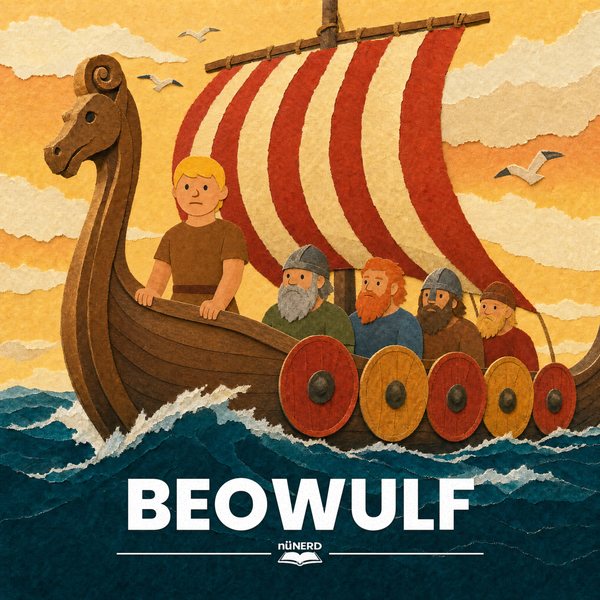
Beowulf
Ages 0–4 · cut paper
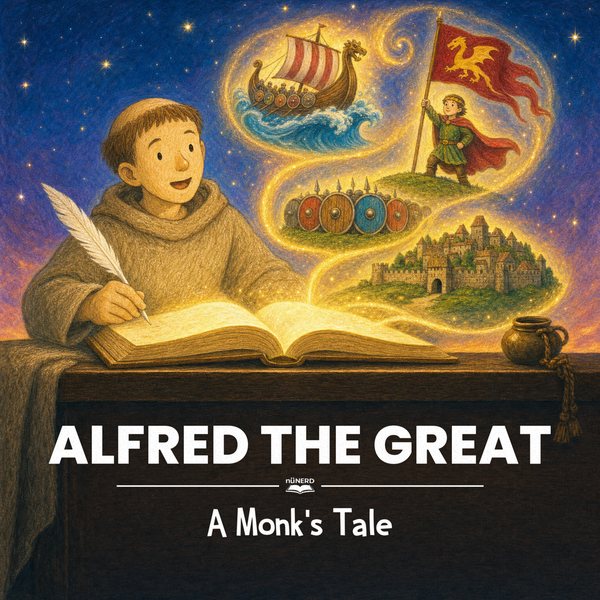
Alfred the Great
Ages 3–7 · crayon
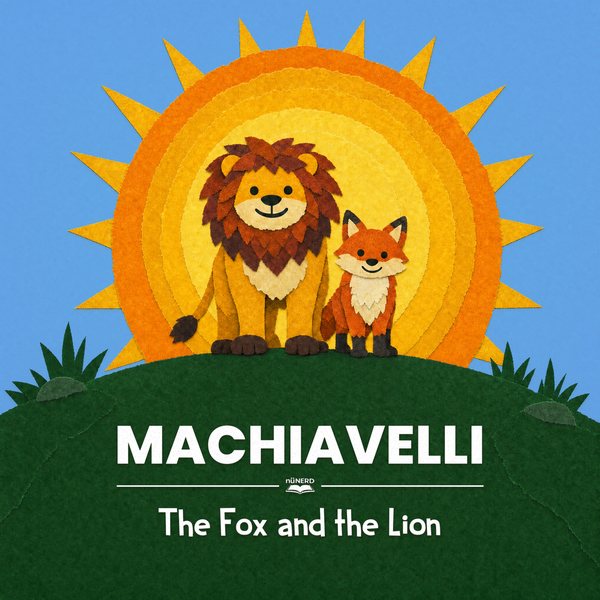
Machiavelli
Ages 0–4 · cut paper
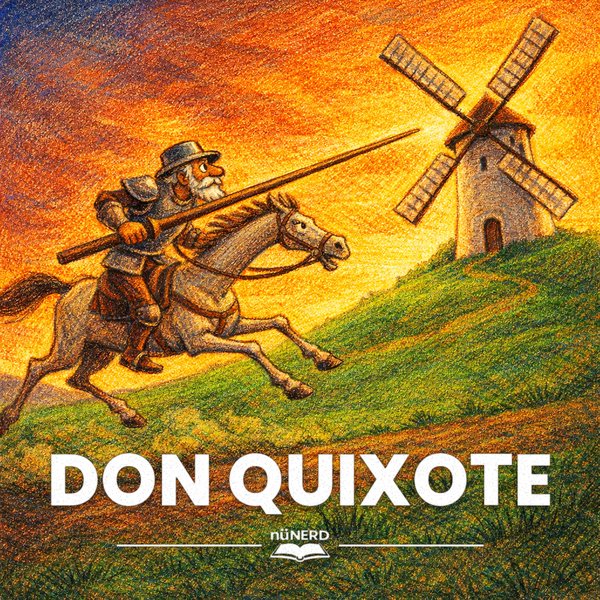
Don Quixote
Ages 3–7 · crayon
About nüNERD
nüNERD makes children’s books on history, philosophy, biography, and classic literature for toddlers to teens, from Beowulf and Don Quixote to Alfred the Great and Plutarch’s Lives. We draft and illustrate them with AI tools, then review and edit them ourselves. The pictures range from the look of cut paper and crayon in the picture books to black-and-white line art and woodcut in the chapter and prep books. Here’s how we use AI.