Plutarch's Lives · Toddlers to teens

Lycurgus & Numa

Lycurgus, Sparta's lawgiver, would not let his laws be written down, so he taught them to the city's children instead. Numa, as the Romans told it, sorted Rome into guilds of potters, dyers, and shoemakers so that two old enemy peoples would mix.

A gray hill town of matching houses and a bright town of many-colored roofs face each other across a river valley at sunset, in cut-paper collage

A page from Lycurgus & Numa: A Plutarch Toddler Book

Why we love it

A bowl of black broth.

In our toddler book the Spartans' dinner is just "the same plain broth," and Lycurgus eats it with a smile. The real dish was the black broth: a king of Pontus bought a Spartan cook just to taste it and found it awful, and the cook told him it only tastes right after a swim in the river Eurotas.

Toddler book, ages 0–4 ↓

Iron money.

In our picture book, Lycurgus replaces Sparta's small shiny coins with bars of heavy iron, so big and clunky that nobody bothers to stack them up. The iron, Plutarch adds, was quenched red-hot in vinegar, so it could not even be reworked into anything useful.

Picture book, ages 3–7 ↓

A god for fence lines.

Numa gave the boundary stones between farms their own god, Terminus, so that shifting one by night became a crime against heaven. Our chapter book tells that much; Plutarch adds that Terminus was to have no blood shed for him, since he was the god of peace and fair dealing.

Chapter book, ages 6–10 ↓

Two stone chests.

Numa asked for his sacred books to be buried in a stone chest beside his coffin, so his teachings would live in his priests' memories instead of on a page. About four hundred years later, by Plutarch's count, the earth washed away, the chests came to light, and a Roman official had the books burned in public.

Prep book, ages 10+ ↓

Which book for your child?

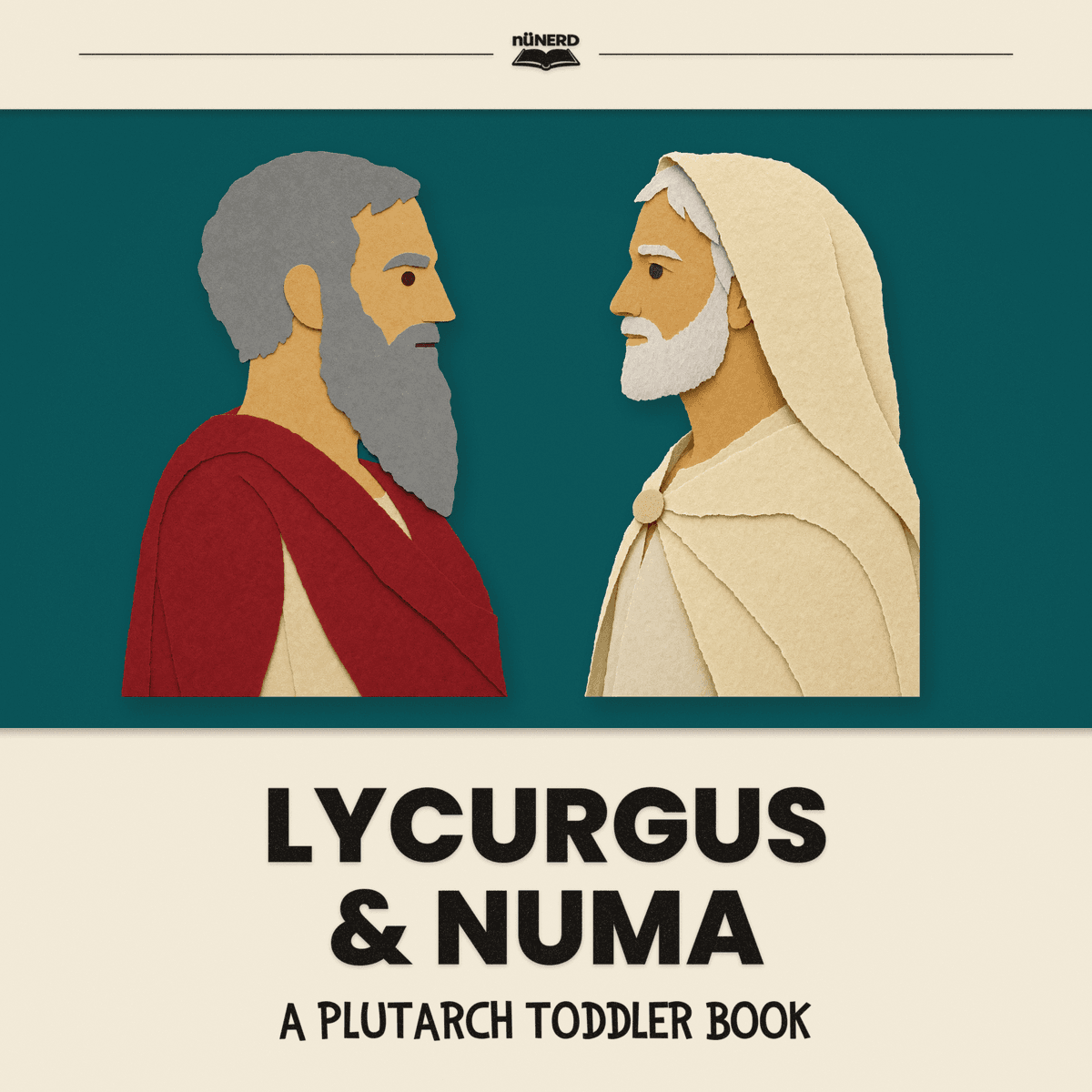
Cover of Lycurgus & Numa: A Plutarch Toddler Book, for ages 0–4

Ages 0–4 · Toddler book · Read to them

Lycurgus & Numa: A Plutarch Toddler Book

In Lycurgus’s Sparta, everyone lives exactly the same: small plain houses that all look alike, even the king’s, and one big hall where all the city eats side by side. In Numa’s Rome, every family lives its own way, and every window at supper glows with a different little meal. Same and different, the game every toddler already plays, turned into a first pair of lives from history. A cut-paper collage picture on every page.

24 pages · about 340 words · cut-paper collage

Good to know
Spartans dress, work, and eat alike, Roman families each go their own way, and the last pages set the two men side by side, all in short, matching lines.
A row of Spartans in matching plain tunics walk in step, each carrying a jug, in cut-paper collage
Everyone wore the same plain coat. No gold. No fancy shoes.
A baker pulls loaves from an oven, a potter works at his wheel, and a man in yellow sings with his arm raised, in cut-paper collage
One grownup baked warm bread. One shaped clay pots. One sang in the street.
Numa, in a white hooded robe, walks through a busy street of colorful houses among families and children playing with a ball, in cut-paper collage
Numa walked among his people. He smiled at each one, and let each one be.
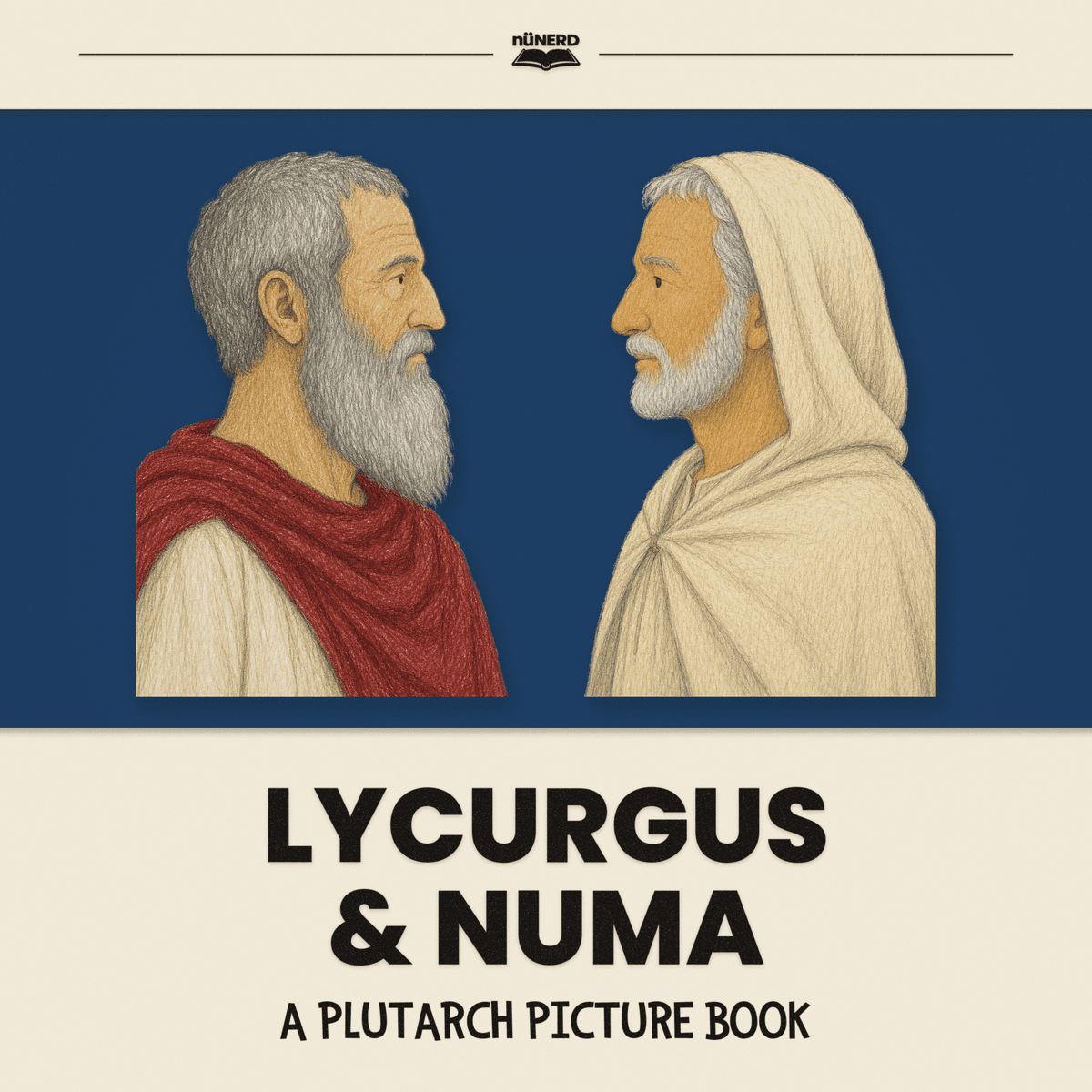
Cover of Lycurgus & Numa: A Plutarch Picture Book, for ages 3–7

Ages 3–7 · Picture book · Read together

Lycurgus & Numa: A Plutarch Picture Book

Lycurgus, whose bed was hard and whose coat was rough, gives Sparta rules as plain as his own life: no piles of gold, and money of heavy iron bars a boy can barely lift. Numa, the quiet farmer who told Rome no before he told it yes, fills the city with festivals and lets each Roman live their own way. Page after page sets up a question to ask together: is it better for everyone to live one way, or for each family to find its own? Soft crayon pictures from first page to last.

36 pages · about 710 words · soft crayon

Good to know
Lycurgus leaves Sparta for good at the end of his half, and the book does not say that he died. Rome's old fighting gets a single line before Numa puts the swords away.
Parents will spot
One line said twice: “If you looked at any Spartan, you saw Lycurgus himself,” and later the same line for Numa and Rome.
Barefoot Spartan boys race across a dusty field while two others wrestle on the ground, in soft crayon
From the time they were small, Spartan children trained together: racing barefoot, wrestling, falling down, and getting back up.
Priests leap down a village street holding up round golden shields as children run alongside, in soft crayon
Once a year, the priests danced through the streets, carrying bright shields that flashed and gleamed in the sun.
A girl paints a tall door bright yellow while Numa, in a white hooded robe, stands beside her and watches, in soft crayon
On one street, a girl painted her door bright yellow, a color no one else had picked. Numa walked by and smiled.
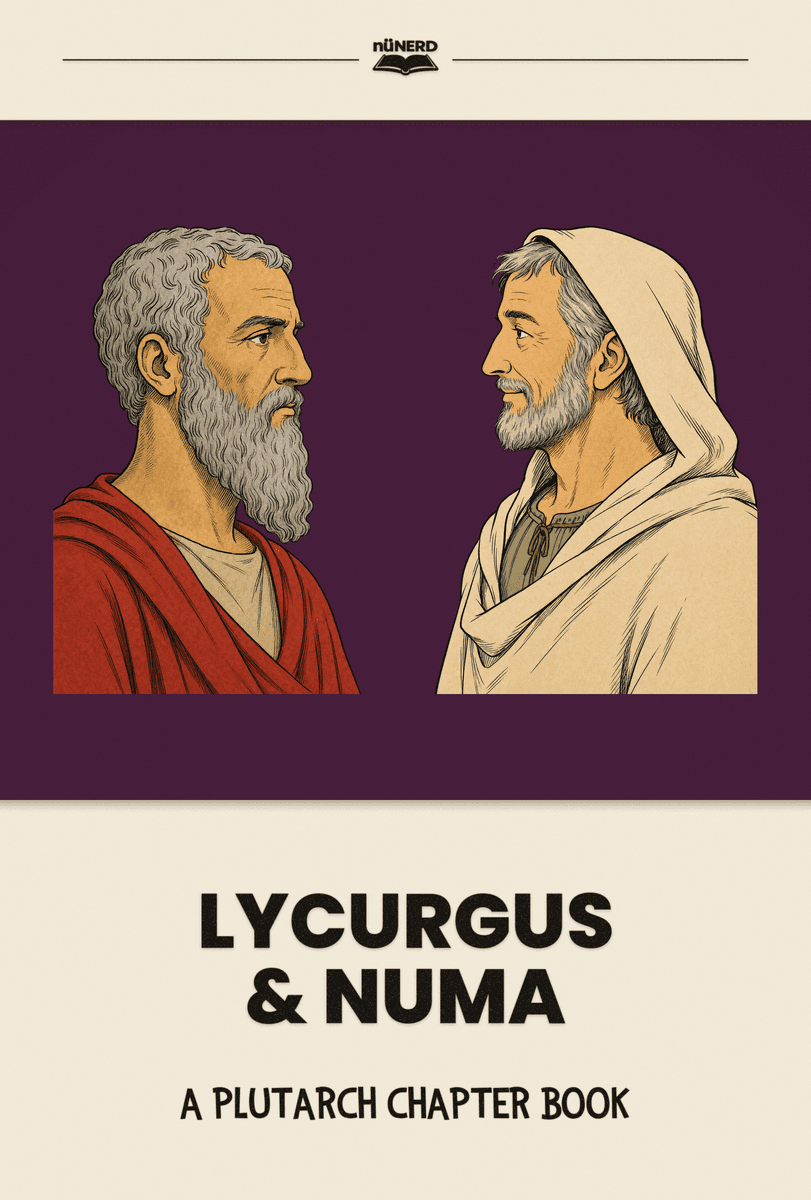
Cover of Lycurgus & Numa: A Plutarch Chapter Book, for ages 6–10

Ages 6–10 · Chapter book · They start reading alone

Lycurgus & Numa: A Plutarch Chapter Book

This chapter book opens with two children waking to opposite mornings, one raised to be a Spartan soldier and nothing else, the other free to become almost anything, then goes back to Lycurgus and Numa, the lawgivers who set those lives in motion before either child was born. Along the way it passes a spirit named Egeria counseling a king in a quiet grove, a shield said to have fallen from the sky, and the eleven perfect copies made so no thief could find the true one. A late chapter retells Plutarch’s comparison in plain language and aims it at the question the pair was built to raise: what kind of rules make a good city? Black-and-white line illustrations throughout.

76 pages · about 7,600 words · 18 black-and-white drawings

Good to know
Spartan boys go barefoot and hungry in their training, and at the end of his life Lycurgus, far from home, stops eating and chooses to die so Sparta can never be released from its promise. Numa dies old and mourned. Sparta's fall gets two paragraphs; Rome's return to war after his death runs several pages, told as the sad end of Numa's story.
Also inside
A closing chapter introduces Plutarch himself and suggests reading the Lives alongside the first book of Livy's history of Rome. Harder ancient names such as Lycurgus, Egeria, and Pythagoras come with a pronunciation.
A Spartan woman stands with one hand on her hip and the other held out as she speaks, a town and hills behind her, in black-and-white line art
Spartan women grew famous all across Greece. They spoke their minds plainly and boldly, exactly the way Spartan men did.
A woman in a long robe stands among old trees and gestures to a hooded man seated on the roots beside a spring, in black-and-white line art
There, alone, in the early morning before the city woke, Numa would slip away to meet a wise spirit named Egeria (eh-JEER-ee-uh).
A small child stands on the steps before a temple's tall double doors, shut tight, in black-and-white line art
The great doors of Janus swung shut. And they stayed shut.
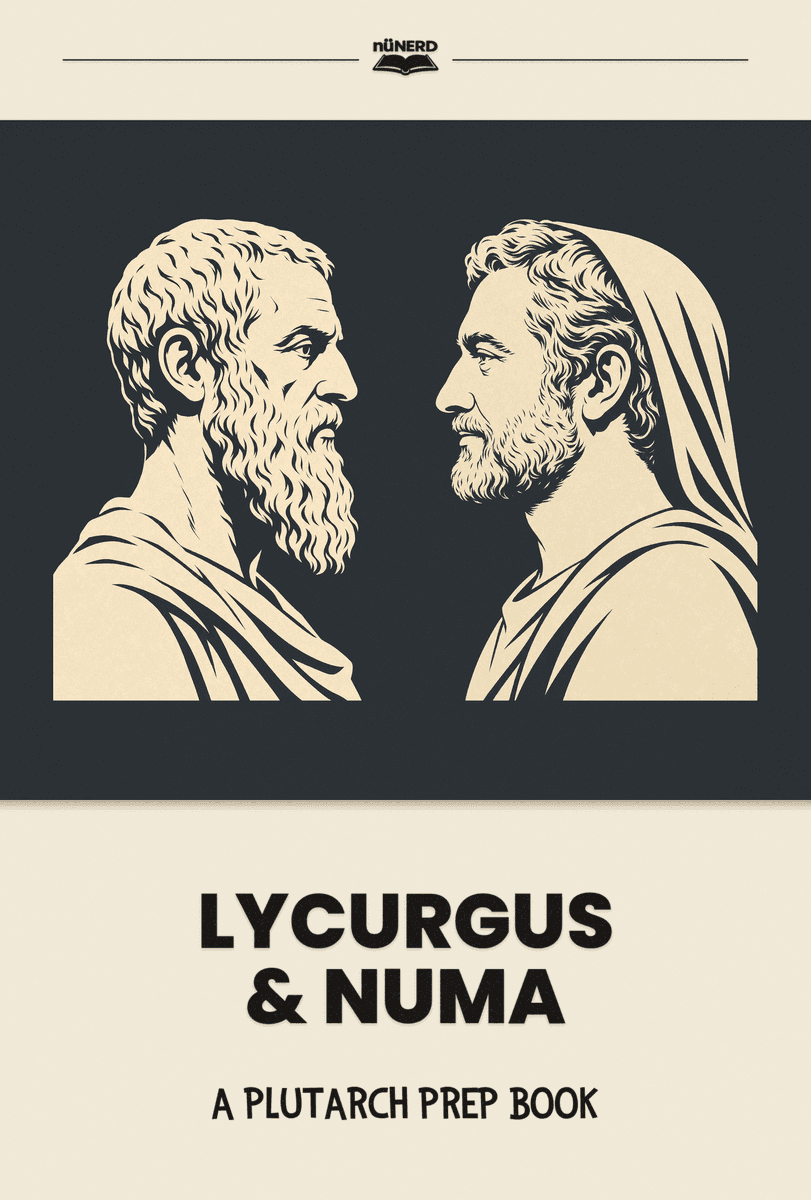
Cover of Lycurgus & Numa: A Plutarch Prep Book, for ages 10+

Ages 10+ · Prep book · Ready for Plutarch

Lycurgus & Numa: A Plutarch Prep Book

Lycurgus pressed Sparta into one stern mold that held for five hundred years. Numa turned warlike Rome toward peace for forty-three years by persuasion alone. The prep book compares the two lawgivers point by point, including the enslaved Helots on whose labor Spartan courage stood. Near the end, a chapter gives Plutarch’s comparison, and your reader decides whether he got it right. Black-and-white woodcuts throughout.

88 pages · about 9,300 words · 18 black-and-white woodcuts

Good to know
Lycurgus's sister-in-law offers to do away with her unborn child so he can keep the throne, and a mob costs him an eye. In the Crypteia, young Spartans go out by night to hunt and kill Helots, the conquered people Sparta enslaved, and Helots are made drunk and shown to Spartan children. Lycurgus later starves himself to death abroad so Sparta can never be released from its oath.
Also inside
An opening chapter on how to weigh two lives, and a closing one pointing readers to the full Lives, starting with the free Dryden translation on Project Gutenberg.
Numa, hooded, stands calmly by a small fire on a stone altar while a young man runs toward him, in black-and-white woodcut
When a messenger rushed up to tell him that enemies were approaching, Numa only smiled and answered, "And I am sacrificing."
Lycurgus, leaning on a staff, looks out over a wide field of evenly spaced grain stacks, in black-and-white woodcut
Looking out across the harvest, the grain stacks standing equal and alike, Lycurgus smiled and said all Laconia looked to him like one family estate newly shared among brothers.
A Spartan soldier with a spear and a round shield stands at attention, in black-and-white woodcut
Sparta valued courage and the strength to suffer without breaking.

The original

The real Lycurgus & Numa

  • Plutarch
  • Written around AD 100
  • Two Lives compared

Plutarch, a Greek writing under the Roman Empire, told the lives of Sparta's lawgiver and Rome's second king, then wrote a short comparison of the two. He admits the old accounts of Lycurgus disagree so badly that no one can even say which century he lived in.

When you want more